Starts the new set of books
Reads data, documents, chart of accounts, history and rules to reconstruct the context of the new company.
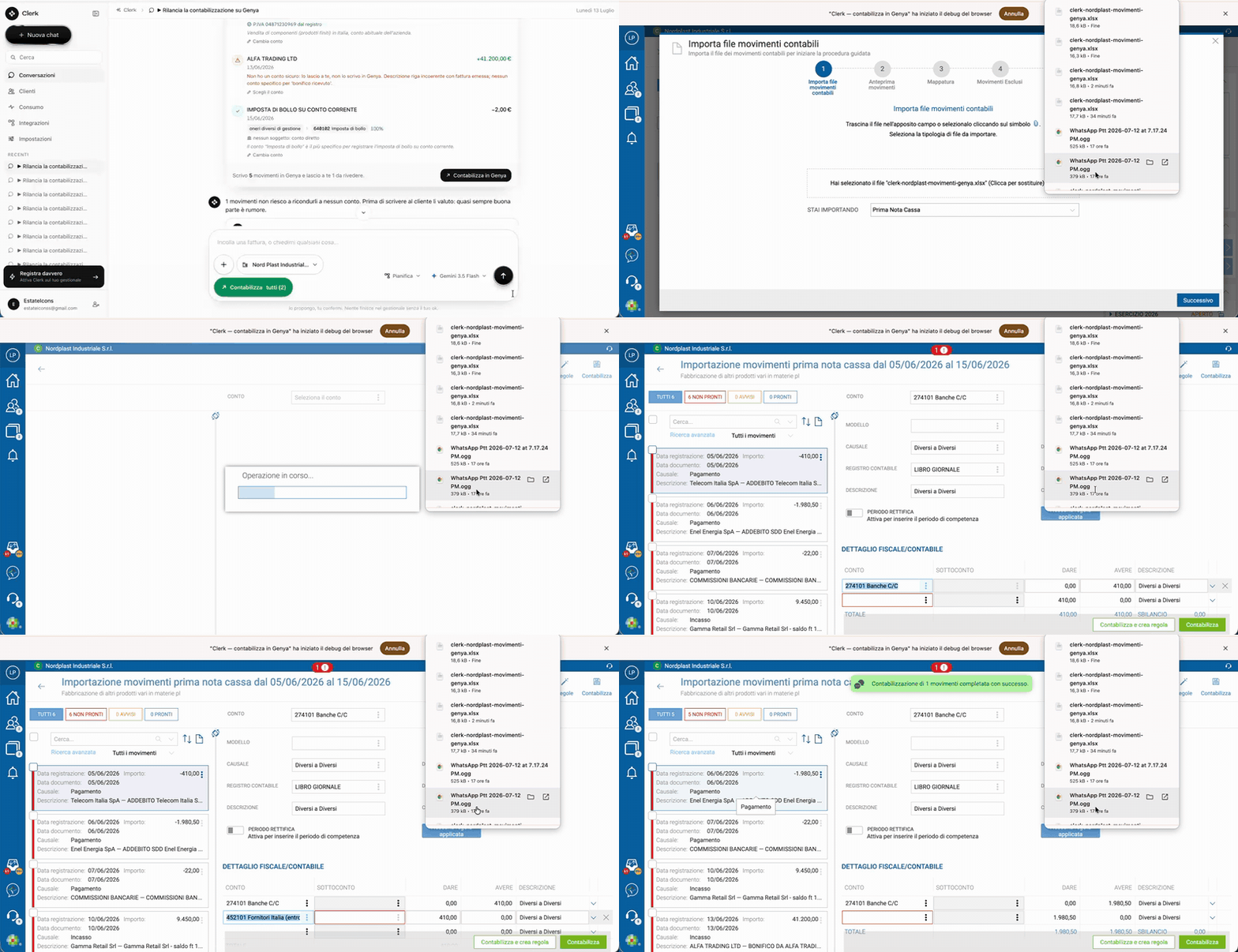
Clerk is the AI bookkeeping colleague that starts and runs new sets of books. It does not merely suggest: it gets into the accounting software through a browser extension, in the firm’s own session, and writes the authorised work into it. It rereads what the team has already posted against fixed rules and says where things do not add up. Today the software it writes into is Genya; for the others you start from a review of an export of yours.
Turn setup costs into productive capacity.
This page deals with the entry of a new company into the firm and the accounting work that follows. It is the phase in which it is necessary to collect data and documents, understand how the company is set up, reconstruct the rules used in the past, operate in the accounting software and check that the records are consistent.
Clerk takes over this work in the accounting software that the firm already uses. Here we explain what information it reads, what activities it performs directly in the software, how it reviews the work carried out by the firm, when it asks the accountant for a decision and how it increases automation in a supervised way.
Reads data, documents, chart of accounts, history and rules to reconstruct the context of the new company.
He doesn't just give suggestions: he uses the accounting software and carries out the work authorized by the firm.
It also checks the entries already made by the team, reports errors and inconsistencies and brings the cases to be decided to the accountant.
Onboarding is not a separate phase from operations: Clerk acquires the context, works in the accounting software, reviews the result and gradually increases what he can manage under supervision.
Clerk takes charge of the new set of books in the accounting software that the firm already uses and builds a verifiable start-up path.
It acquires personal data, invoices, movements, documents and available exports without asking the firm to reconstruct the context manually.
Analyzes the chart of accounts, the history and the way in which the firm has already dealt with recurring operations and cases.
Performs the first operations in the accounting software screens and brings the completed entries for review, with the uncertain cases already separated.
Review your own work and that already done by the team. Each confirmation or correction refines the context of the individual company.
Clerk progressively automates what it has learned and continues to ask the firm for decisions it cannot yet make.
If an invoice follows a rule already confirmed in the company's history, Clerk registers it in the accounting software with the consistent account and brings it up for review when it is already complete.
If a transaction does not have a clear reason or introduces a new case, Clerk does not hide it within the automatic flow: it isolates it, shows the context and asks the accountant how to treat it.
Carry out the accounting in the accounting software, check the work already done and increase your autonomy only on the activities that the firm has validated.
Operations
From transaction list to recording: Clerk enters the flow already used by the firm and completes the authorized steps.
Review
Re-reads account, reason, document and history; it highlights only what requires checking.
Context
Chart of accounts, history, rules and corrections remain linked to the individual accounting.
Decisions
Before asking, collect documents, history and alternatives: the accountant is left with a limited choice.
Learning
Executes already confirmed cases, brings similar ones for review and stops new cases.
Want to see it on real books? Bring a set of your own and we will go through it together.
Book a demoEvery new company stops requiring weeks of setup, coaching and data entry before becoming profitable. Startup becomes guided; the next job, supervised automation.
Configuration
A guided onboarding that captures data, documents and accounting context.
Support
Clerk reads history and rules, works in management and immediately brings the first entries for review.
Marginality
Clerk performs repetitive work and reviews the result; the judgment remains with the accountant.
The accounting software gives you the functions to configure, record and control. Clerk does the work: understands the accounting, operates the software and reviews what has been recorded.
It gives you features and screens to set up the company.
Reads what exists and operationally sets up the new set of books.
Maintains chart of accounts, master data and records.
He interprets them together with the history and the rules of the firm.
Allows the team to insert and edit entries.
Use the accounting software screens and carry out the authorized processes.
Makes data and records available for review.
Rereads the work done, reports errors and suggests how to correct them.
Chart of accounts, master data, accounting history, firm rules and data and documents available for the new company. The actual sources depend on the accounting software and the flow of the firm.
No. The accounting software remains the firm's accounting system. Clerk uses it operationally: navigates the screens, carries out authorized work and updates the work in the same environment already used by the team.
Through a browser extension, working in the session the firm has already opened: the credentials stay yours and you never hand them over. Clerk opens the screens of the accounting software and writes into them the way a colleague sitting at that desk would, and after each entry it reads back to check it went through. It is not a link between systems: it is an operator. The flip side is that when the software vendor changes the screens the extension has to be updated, which is why we keep watch on the vendor’s roadmap.
We will tell you straight away, so you do not have to fill in a form to find out: today Clerk works inside Genya, and that is the only accounting software it writes into. Getting inside a piece of accounting software means writing an operator for it, screen by screen, and there is no switch that turns them all on. If you use TeamSystem, Zucchetti, Profis or anything else, automatic posting is not there today and you would have to wait for your own software; the review — the part that rereads what has already been posted — we can run on an export of yours, without touching the software, and tell you what it finds. We would rather say so now than after three meetings.
The accountant, as with a colleague’s work: responsibility for the accounts and the tax returns cannot be transferred to a piece of software, and we are not selling you that. This is why Clerk posts on its own only where the firm has already confirmed that treatment, stops where it is unsure instead of guessing, and leaves a record of what it did and when, line by line: you can always tell what it wrote and what you wrote.
They are two separate layers, and the whole thing rests on that distinction. To propose an entry Clerk looks at how previous ones went: that is a clue, and as such it can also inherit the bad habits of whoever came before. To review, on the other hand, it uses neither the history nor AI: it applies fixed rules that give a true or false answer. A payment to a supplier that is matched to no invoice is an error, not an opinion. Where the rule is only a suspicion it says so as a warning, and where it lacks the data to rule at all it stays silent and tells you, rather than passing the gap off as a check that was cleared. A reviewer who gets one finding wrong out of twenty is ignored on all twenty.
We are not giving you a percentage, because it depends on how regular your companies are and we would not know beforehand. What we will tell you is how it grows: at the start Clerk posts and brings everything to review, and it takes on a type of operation by itself only after the firm has confirmed that treatment several times. The scope starts narrow — the most repetitive and regular cases — and widens from there. «Authorised» means this, in practice: not a single switch that turns everything on, but one type of operation at a time, switched on by you and switchable off by you. Outside that scope it does not try: it stops and hands it to you. Credit notes, transfers between accounts, accruals and prepayments, withholding tax and the less straightforward VAT cases are work for a professional, and until they enter the confirmed scope they stay yours.
the accountant. Clerk isolates decisions it can't yet automate, shows available context, and learns from the confirmed choice.
Let's start with a new real set of books, from the accounting software you use and from the data available. This way we can see how much onboarding, how much operation and which audit controls Clerk can take over.
Data and responsibilities are described inprivacy information and in conditions of service.
Indicate the accounting software you use and how many new sets of books enter the firm on average. In the comparison we reconstruct your onboarding, check which operations Clerk can perform in the accounting software and which checks he can carry out on the work already produced by the team.
What it costs
Seats times the plan price, plus a band that depends on the clients you keep on file.
Studio
29 €
per seat, per month
the whole chain
Studio Plus
49 €
per seat, per month
when there is more than one of you
Network
69 €
per seat, per month
more companies, your own brand
Client band: up to 50 records included, then €19 to €79 a month, one per firm.